


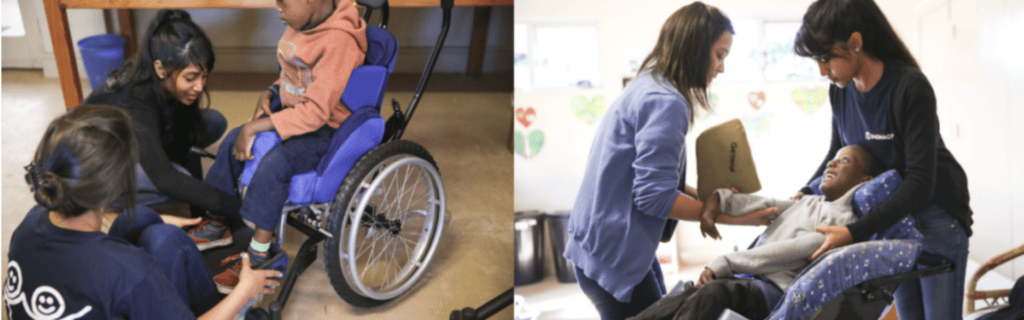
When people think about wheelchairs, they often think about mobility.
Will it help a child move around independently? Can it get through doorways? Will it work on the roads, pathways and surfaces where they live?
These are important questions. But there is another aspect of wheelchair provision that deserves just as much attention: how a child is positioned while sitting.
For children who spend significant time in a wheelchair, seating is about far more than comfort. It influences posture, movement, communication, learning, participation and long-term physical wellbeing.
In many cases, the effects of poor positioning develop gradually. A child may lean to one side, slide forward in their seat, struggle to keep their head upright, or become tired more quickly during everyday activities. These changes can seem small at first, but over time they may contribute to avoidable secondary complications that become increasingly difficult to address as a child grows.
That is why appropriate seating matters.
What Does “Appropriate” Actually Mean?
When clinicians talk about an “appropriate wheelchair”, the word appropriate has a very specific meaning.
According to the World Health Organization (WHO), an appropriate wheelchair is one that:
- Meets the user’s individual needs and environmental conditions
- Provides proper fit and postural support
- Is safe and durable
- Is available within the country
- Can be maintained and repaired at an affordable cost
In other words, an appropriate wheelchair is not simply a chair with wheels. It is a mobility and positioning system that supports a child’s body, daily activities and long-term development.
Why Positioning Is So Important
Children’s bodies are constantly growing and changing.
For children with physical disabilities, maintaining a comfortable and supported sitting position can sometimes be challenging. Without adequate support, children may gradually adopt positions that are uncomfortable, difficult to maintain, or harder for their bodies to sustain as they grow.
Good postural support helps children maintain a more upright and stable position. This can improve comfort, reduce fatigue and make it easier to participate in everyday activities such as learning, eating, communicating, playing and interacting with others.
Appropriate seating may include cushions, pelvic supports, trunk supports, headrests, armrests or foot supports, depending on the child’s individual needs and abilities.
These components are not accessories. They are often essential for supporting posture, comfort and function.
When a Wheelchair Does Not Fit Properly
A wheelchair that is too wide, too narrow, too long or too short may affect how a child sits and moves throughout the day.
You may notice that a child:
- Leans consistently to one side
- Slides forward in the seat
- Struggles to keep their head upright
- Appears uncomfortable after sitting for extended periods
- Has difficulty reaching wheels, trays or learning materials
- Frequently requires repositioning
Over time, poor positioning may contribute to pressure injuries, pain, fatigue, reduced function, contractures and the progression of postural asymmetries.
While not every complication can be prevented, appropriate seating and regular review can play an important role in reducing unnecessary risks.
One Size Does Not Fit All
An appropriate wheelchair must also suit the environment in which it is used.
A child travelling to school along gravel roads has different mobility needs from a child who spends most of their day indoors. A family living in a rural area may require equipment that can withstand rough terrain and be easily maintained if repairs are needed.
The most suitable wheelchair is not necessarily the newest or most expensive option.
It is the one that safely supports the child, meets their daily needs and allows them to participate as fully as possible in family life, school and their community.
Helping Ensure the Right Fit and Support
Many families work with the resources available to them. A wheelchair may be prescribed, donated or provided through a funding programme, and parents often trust that what has been supplied is appropriate.
Yet parents and caregivers remain some of the strongest advocates for their children.
It is okay to ask questions.
If your child is receiving a wheelchair, consider asking:
- Does this wheelchair fit my child properly?
- Is my child’s posture well supported?
- Will it meet their needs as they grow?
- Is it suitable for the environment where we live?
- Can it be adjusted when necessary?
- Are repairs and spare parts available locally?
These questions can help ensure that a wheelchair supports not only mobility, but also comfort, health and participation over time.
Looking Beyond Today
Appropriate seating is not about achieving perfect posture.
It is about giving a child the support they need to be comfortable, engaged and able to participate in everyday life.
A well-fitted wheelchair can help a child interact more easily with their environment, conserve energy for the activities that matter, and reduce the risk of avoidable complications developing over time.
Many families only discover the importance of seating and positioning when challenges have already started to emerge. Yet small adjustments made early can often make a meaningful difference in comfort, function, and wellbeing.
At Shonaquip Social Enterprise, we believe every child deserves the opportunity to grow into a participating adult. Appropriate seating is one of the foundations that can help support that journey.
If you have questions about wheelchair fit, posture, positioning or mobility support, our team is always happy to help. Call or WhatsApp us on +27 (0)71 371 9103 for guidance or additional information.
Because sometimes a small adjustment today can make a meaningful difference for years to come.

0 Comments